March 2026
·7 min read
Six Years, Sixteen Countries and Everything In Between: Building Whoppah
When I came back from two months in Latin America in early 2018, I had a notebook full of reflections and a head full of ideas. Pritle had been sold. The chapter was closed. And somewhere between the mountains of Chile and the coastline of Argentina, a new one started forming.
I had proven to myself that you could build something meaningful from scratch, with a small team, a clear idea, and enough conviction to push through the moments where it all felt like it might fall apart. The question was never really whether I would start something new. It was what, and when.
The answer arrived through a gap I kept noticing everywhere I looked. The secondhand market for design interiors in Europe was completely fragmented, largely offline, and almost entirely without the kind of trust layer, technology, and curation that would make it genuinely work at scale. There were billions of euros worth of beautiful furniture sitting in homes across the continent, changing hands through classified ads, unreliable marketplaces and word of mouth. Nobody had built the category properly. I wanted to.
In 2019, together with my co-founder and wife Evelien, I launched Whoppah in the Netherlands.
Starting With a Vision, Not a Playbook
One of the things I have learned across two startups now is that the founders who succeed are rarely the ones who had the most detailed roadmap. They are the ones who had the clearest sense of what they were trying to achieve and the flexibility to change almost everything else along the way.
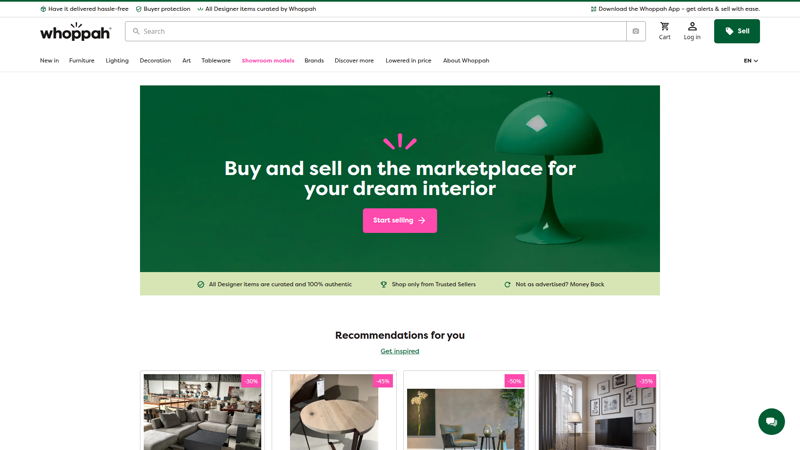
With Whoppah, the vision was always about more than a marketplace. We were building infrastructure for the circular economy in interiors. A place where buying and selling secondhand design furniture would be as trustworthy, as beautiful, and as easy as buying new. Where quality would be curated, not crowdsourced. Where the experience would feel premium, because the category deserved it.
That vision has held. Almost everything around it has changed at least once.
We launched in the Netherlands with a focus on curated design interiors and started building the core marketplace infrastructure from scratch. Everything was in-house from day one: the web platform, the iOS and Android apps, the backoffice, the seller tools, the moderation systems. This wasn't the cheapest or fastest route. But it meant that every capability we built, we owned. And that ownership would become one of our most important assets as the business evolved.
What Six Years of Iteration Actually Looks Like
I want to be honest about what building Whoppah has involved, because the polished version of the story doesn't do justice to the reality.
In 2020 and 2021 we were scaling hard, learning the limits of user-generated content, testing pricing models, experimenting with buyer fees, and launching a professional photography service to improve listing quality. We grew supply and demand aggressively. We learned what didn't work as much as what did.
In 2022 we ran a significant logistics experiment, building an in-house warehouse and courier fleet. The ambition was to own the end-to-end experience for bulky item delivery. It was one of the most instructive things we ever did, and one of the most expensive. The unit economics didn't support it at our scale. We internalised the lesson, outsourced the model, and moved on faster and leaner.
In 2023 we rebuilt the technology stack for internationalisation and expanded across six countries: the Netherlands, Belgium, Germany, France, Italy and wider Europe. We built a localisation engine with multi-currency, multi-language, auto-translation, and SEO automation. The foundation was ready for scale.
In 2024 we expanded into 10 more European countries and we made acquisitions to accelerate our position in France and expanded our scope from design-only to all interiors, which significantly broadened our addressable market and supply base. We also completed the shift to an asset-light logistics model, which fundamentally improved our unit economics.
In 2025 we executed what I am genuinely proud to call one of the most disciplined pivots I have seen at a company of our size. We made a deliberate decision to reduce GMV volume during the first months in unprofitable channels, tightened the team, outsourced marketing, and consolidated everything around profitability and operational efficiency to regain profitable growth throughout the year. EBITDA improved by €5 million in a single year. App sales tripled compared to 2023. AI reduced ad creation time from five minutes to thirty seconds. Repeat buyer share grew to 40 percent. These were not vanity metrics. These were the signals of a business that had genuinely turned a corner.
The Honest Truth About Building in a Hard Category
There is a version of the Whoppah story I could tell that glosses over the difficulty. I am not going to do that, because I think it is one of the most important chapters for any founder building in a complex category to understand.
The secondhand interiors category has real structural headwinds that do not go away simply because your product is good. Purchase frequency is low. The average customer buys once or twice a year, compared to eight to twelve times in fashion. Logistics are complex and expensive, because large fragile items require specialised last-mile handling that erodes margins. Trust is harder to establish, because quality assessment is subjective and order values are high enough that buyers hesitate. And discovery is genuinely difficult, because unique secondhand items resist the kind of keyword-based search that works well for commodities.
Every player in our European competitive set is navigating the same headwinds. Understanding this matters, because it reframes the challenge correctly. It is not primarily an execution problem. It is a category problem, and the solution requires structural innovation, not just better marketing or faster growth.
This is what has shaped our strategic thinking over the past few years. We stopped chasing volume for its own sake. We started asking harder questions about what we are actually providing and why it is genuinely valuable. And we arrived at an answer that I believe is the right one.
The unit of value we provide is not a transaction. It is certainty. When someone buys a secondhand sofa for €800 through Whoppah, what they are really purchasing is the assurance that the item is as described, that the logistics will work, that the payment is secure, and that if something goes wrong there is a layer of protection between them and the problem. That assurance is what justifies our role in the process and what separates us from a classifieds board.
What We Are Actually Building
That reframing has shaped everything about how we develop the platform.
Our AI moderation handles real-time safety and quality detection at scale. Our Auto-Listing tool guides sellers through the capture and enhancement of their listings, reducing friction dramatically and improving supply quality. Our shipping engine integrates dynamically with carrier APIs to price and route deliveries. Our backoffice gives us a central command for operations, fraud detection and customer success. And our AI image and natural language search, which we are improving in 2026, directly addresses one of the category's most persistent pain points: the fact that unique secondhand items are genuinely hard to find through conventional text-based search.
All of this is built in-house. Proprietary. Six years in the making. When I look at the technology stack we have assembled, I see not just a marketplace but a genuine infrastructure layer for circular commerce in interiors. That is the asset. That is what grows in value as the category matures.
We are also, in 2026, building Whoppah Go, our owned logistics solution for bulky items. The ability to guarantee the last-mile experience for a large, fragile, high-value piece of furniture is the piece that has eluded every player in this category. We are investing in solving it, because we believe it is the piece that, when solved, becomes a durable competitive moat.
Building Something That Lasts
In 2025 we crossed into modest profitability. For a company that spent its first five years investing heavily in platform, expansion and category development, that is a meaningful milestone. It is not the destination. But it is proof that the fundamentals work.
1 million people visit Whoppah every month across sixteen countries. We have 170,000 active listings. We are generating tens of millions in annual GMV with a team of 16 FTE and a fully proprietary technology platform. By almost any efficiency metric, we are the most capital-efficient secondhand interior marketplace in Europe. That matters, and I do not say it to congratulate ourselves. I say it because efficiency, when it is genuine and structural, compounds. It becomes the platform from which the next phase of growth is launched. Even though our aspirations go way beyond where we are today.
The 2026 roadmap is the most ambitious we have had. AI-powered features across the full buyer and seller journey. New revenue model experiments. Continued international expansion. A financial forecast targeting strong GMV growth and positive EBITDA. These are not aspirational perspectives. They are the product of six years of learning what this category actually needs and building the capabilities to serve it.
Why I Am More Optimistic Now Than at Any Earlier Point
Building Whoppah has been harder, in some ways, than building Pritle. The category is more operationally complex. The timeline to profitability has been longer than I anticipated. There have been moments of genuine difficulty that I would not sugarcoat.
And yet I find myself, in early 2026, more optimistic about what we are building than at any earlier point in the journey.
Part of that is the numbers, which are moving in the right direction across every metric that matters. But a larger part comes from something harder to quantify. It comes from the quality of the team we have built, lean and deeply aligned. From the technology platform we own outright, which is now a genuine competitive asset. From six years of hard-won understanding of what this category actually requires that no competitor can simply replicate.
And it comes from a conviction I have held since before I ever drew the first sketch for Pritle in 2013. The founders who stay in the arena long enough to learn what the category actually needs, and who build the discipline to execute against that knowledge, are the ones who eventually win.
We are still in the arena.
The journey continues.
Explore More

Written by Thomas Bunnik
Thomas Bunnik is a Dutch serial entrepreneur and investor. Co-founder & CEO of Whoppah, Europe's largest secondhand design marketplace. Founder of Pritle (acquired by BinckBank for €12.5M).
Learn more →Enjoyed this article?
Follow me on LinkedIn for new articles and updates on building companies.